The Tagvenue Work Social Index 2026: How Companies Are Bringing People Together


What hundreds of thousands of corporate venue enquiries reveal about meetings, workplace socials, event budgets and company culture in 2026.
For decades, the office Christmas party was the defining moment of the corporate calendar. It was the one occasion each year when colleagues stepped away from their desks, celebrated the successes of the past 12 months and spent time together outside the day-to-day pressures of work.
In 2026, that tradition still matters, but it no longer carries workplace culture on its own.
- How are workplace socials changing in 2026?
- What is the Tagvenue Work Social Index?
- Key findings from the Tagvenue Work Social Index
- Office social calendars are expanding beyond Christmas parties
- Which corporate events are most likely to become confirmed bookings?
- Is Thursday the best day for corporate events?
- Companies book Christmas parties three months ahead and meetings two weeks ahead
- Smaller, more frequent gatherings are beating one large annual event
- London leads corporate event demand, but not booking commitment
- Corporate event demand is recurring, not one-off
- What the Work Social Index tells us about company culture in 2026
- Corporate event planning checklist for 2026
- FAQs: Corporate events in 2026
How are workplace socials changing in 2026?
Workplace socials are becoming smaller, more frequent and more purposeful. Instead of relying on one major Christmas party each year, companies are creating regular opportunities for teams to connect throughout the calendar.
These moments now include:
- Team lunches
- Department socials
- Workshops
- Away days
- Training sessions
- Networking events
- Seasonal celebrations
Rather than waiting 12 months for one big celebration, many organisations are investing in steady, repeated moments that help colleagues build relationships over time.
What is the Tagvenue Work Social Index?
The Tagvenue Work Social Index is a view of how businesses celebrate, collaborate and connect through corporate venue bookings. It is built from corporate venue enquiries and confirmed bookings across the UK, Australia, Singapore and the US.
The Index shows a clear shift in workplace culture. Teams are no longer coming together around one annual celebration alone. They are building culture through a calendar of smaller, more regular moments throughout the year.
Key findings from the Tagvenue Work Social Index

The 2026 Work Social Index found that:
- Networking enquiries grew by 95% between 2024 and 2025.
- Training-session enquiries increased by 78%.
- Workshop enquiries increased by 70%.
- Christmas party enquiries grew by 32%.
- Thursday generated around 25,000 corporate enquiries, compared with approximately 14,000 on Friday.
- The median booking lead time was 87 days for Christmas parties and just 17 days for meetings.
- Groups of 10 people or fewer converted at around 42%, compared with 6% for groups of more than 250.
- Just over 40% of corporate enquiries had a budget below £500.
- Around half of the companies that made a corporate booking in a given year went on to book at least one more event.
- UK corporate enquiry-to-booking conversion increased from 21.2% in 2023 to 26.6% in 2025.
- Glasgow and Leeds recorded higher corporate conversion rates than London.
At a glance: networking, training and workshop enquiries all grew more than twice as quickly as Christmas party enquiries between 2024 and 2025.
Office social calendars are expanding beyond Christmas parties
Office social calendars now stretch well beyond the annual Christmas party. Businesses are booking away days, summer parties, networking events, workshops, training sessions, client dinners and smaller team gatherings throughout the year.
Some of these event types are growing faster than traditional festive parties. Over the last three years:
- Networking enquiries grew by 95%.
- Training-session enquiries grew by 78%.
- Workshop enquiries grew by 70%.
- Christmas party enquiries grew by 32%.
- General corporate party enquiries grew by 29%.
Which corporate events are most likely to become confirmed bookings?
Meetings and workshop-style enquiries are more likely to convert into confirmed bookings than party enquiries. Meeting enquiries convert at roughly 41%, compared with around 14% to 16% for corporate and Christmas parties.
The difference may come down to booking intent. Meetings, workshops and training sessions are often organised by repeat corporate customers with a clear operational need. A Christmas party is more likely to be planned by someone comparing several venues for one annual occasion.
Is Thursday the best day for corporate events?
Thursday is now the strongest overall day for corporate events, based on Tagvenue enquiry and conversion data. It attracts almost twice as many corporate enquiries as Friday and also performs better as a booking day.
Friday has traditionally been seen as the natural day for work socials, but the data tells a different story. Tuesday, Wednesday and Thursday all generate higher enquiry-to-booking conversion rates than Friday.
Typical conversion rates were:
- Tuesday: approximately 22% to 26%
- Wednesday: approximately 22% to 26%
- Thursday: approximately 22% to 26%
- Friday: approximately 18%
Thursday’s popularity may reflect a shift in how teams use the working week. Employees may prefer to keep Fridays flexible, venues may have greater midweek availability, and hybrid working may make Thursday the day when the highest number of colleagues are already together.
For organisers, Thursday’s popularity can also mean more competition. Companies planning a large Thursday event may need to start their venue search earlier, especially during peak periods.
Companies book Christmas parties three months ahead and meetings two weeks ahead
How far ahead companies plan depends heavily on the type of event. The median time between making an enquiry and holding the event was:
- 87 days for Christmas parties
- 80 days for summer parties
- 17 days for meetings
In practical terms, a company hoping to secure a strong choice of Christmas party venues should ideally be finalised in September.
Meeting rooms and smaller working sessions can often be arranged within a fortnight.
How does lead time affect booking conversion?

Enquiries made at shorter notice are considerably more likely to become confirmed bookings.
- Enquiries made less than one week before an event converted at approximately 36%.
- Enquiries made more than six months ahead converted at approximately 9%.
This does not mean businesses should deliberately leave important events until the last minute.
Larger events naturally require more planning. A company booking for hundreds of people may need approval from several departments, detailed supplier arrangements and greater venue flexibility.
However, a longer planning window also creates more opportunities for:
- Budgets to change
- Internal approval to be delayed
- Guest numbers to move
- Alternative quotes to be requested
- The proposed date to change
- The event to be postponed or cancelled
The closer the event date, the more likely it is that the organiser has a confirmed budget, headcount and reason to book.
Christmas parties are typically planned 70 days earlier than meetings.
Smaller, more frequent gatherings are beating one large annual event
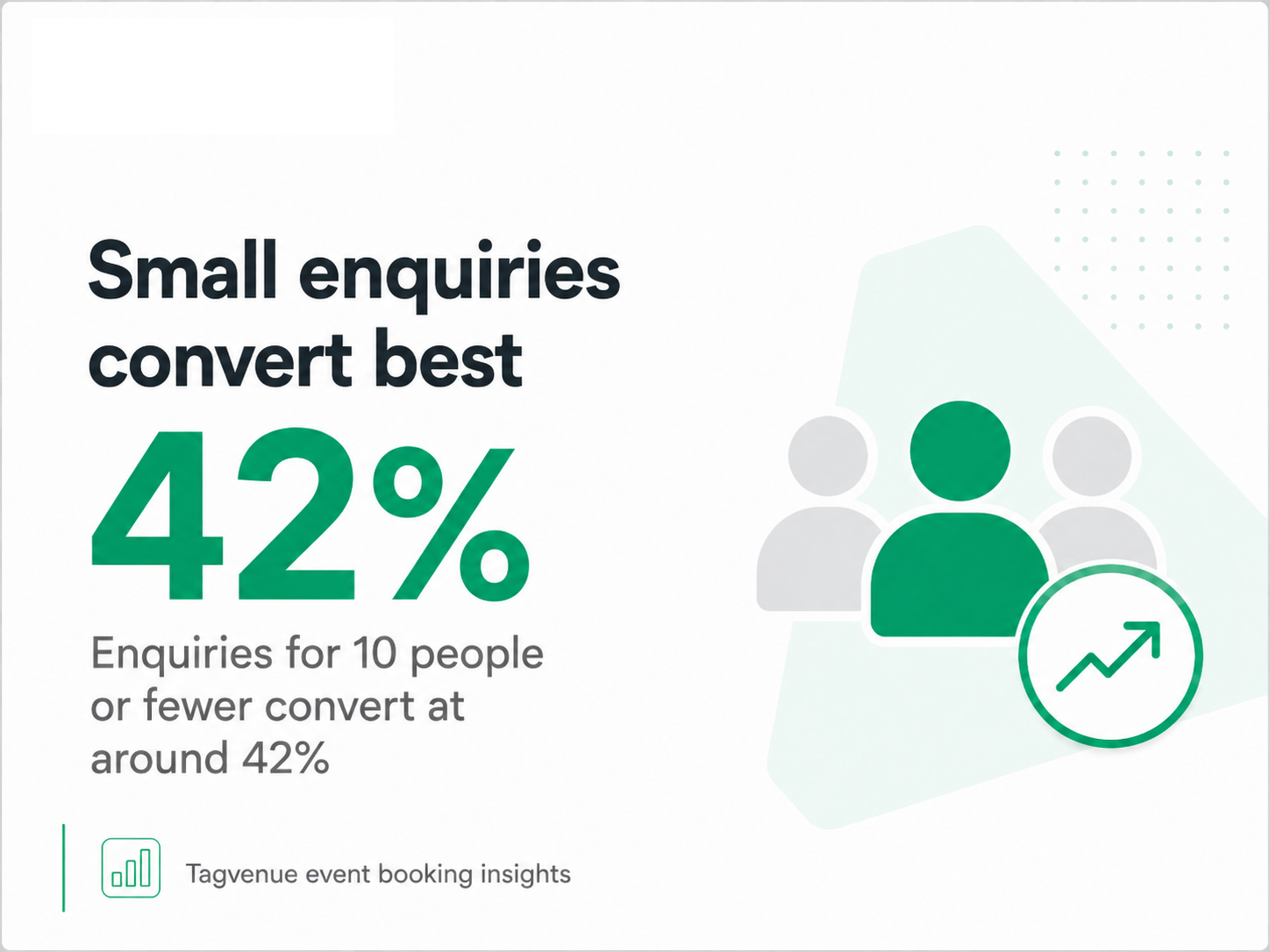
The clearest behavioural change in the data may be the size of the events businesses are organising.
Groups of 1–10 and 11–25 people are the two largest corporate enquiry categories by volume.
They are also dramatically more likely to become confirmed bookings than major events.
- Enquiries for 10 people or fewer convert at around 42%.
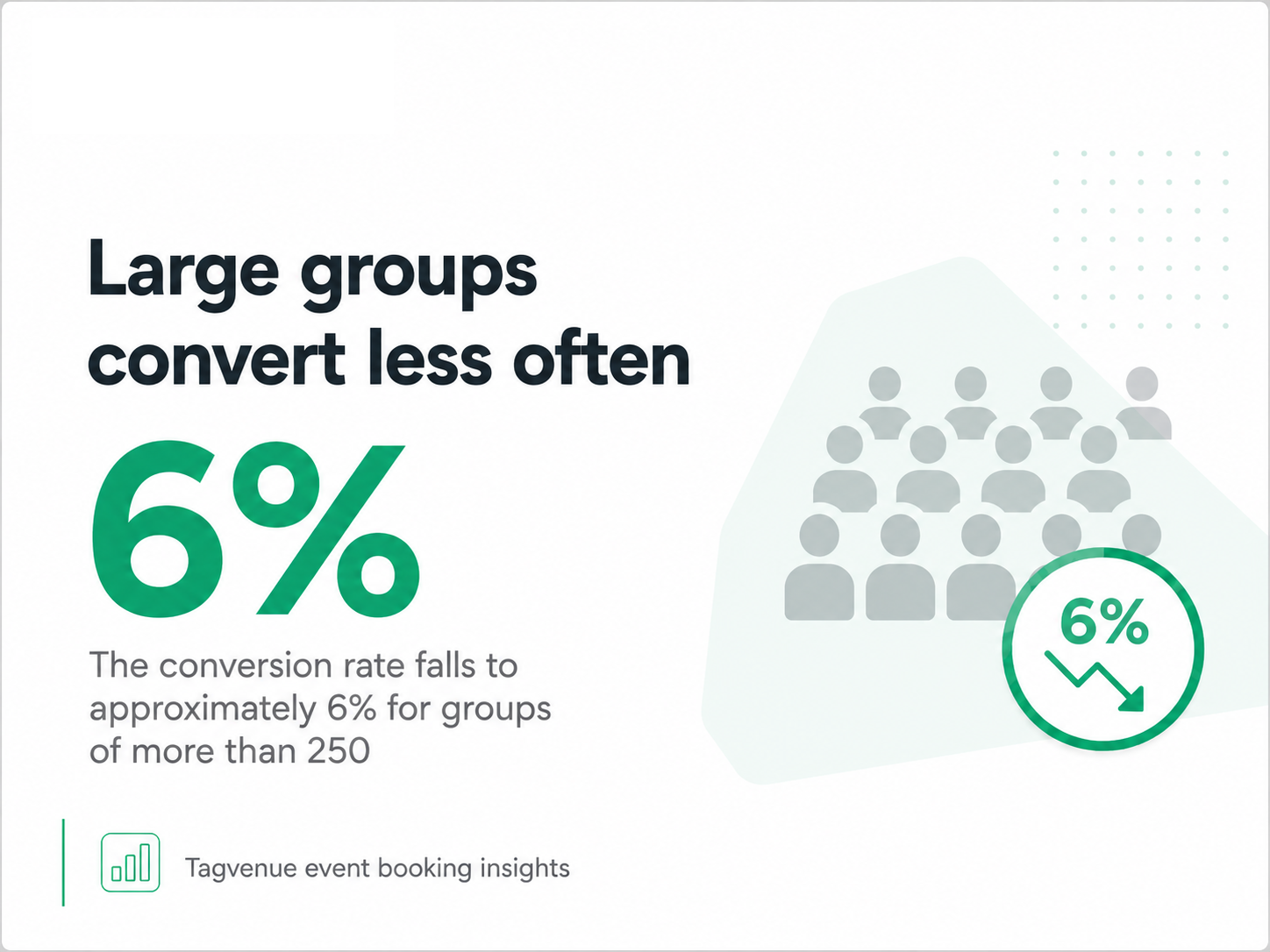
- The conversion rate falls to approximately 6% for groups of more than 250.
Budget follows a similar pattern.
Just over 40% of all corporate enquiries had a budget below £500. This segment converted at almost three times the rate of enquiries with budgets above £5,000.
Corporate events for 10 people or fewer were seven times more likely to convert than events for more than 250 people.
London leads corporate event demand, but not booking commitment
London generates by far the largest volume of corporate venue enquiries in the Tagvenue dataset.
That is unsurprising given the capital’s population, number of businesses and concentration of company headquarters.
However, conversion rates tell a different story.
Corporate enquiry-to-booking conversion was approximately:
- 38% in Glasgow
- 30% in Leeds
- 25% in Birmingham
- 25% in Edinburgh
- 24% in London
London therefore attracts the greatest level of interest, but companies in several regional cities appear more likely to commit once they make an enquiry.
This may reflect differences in venue supply, competition, event budgets or the number of options companies consider before making a decision.
Which cities have the highest corporate event budgets?
New York and Los Angeles recorded the highest median corporate budgets of the cities included in the Index, both exceeding £1,100.
Several cities also stood out for shorter booking windows. Glasgow, Dallas, New York and Perth all had median lead times below 37 days.
The findings show that the largest corporate events market is not necessarily the most decisive or the fastest-moving.
Glasgow converted corporate enquiries at around 38%, compared with approximately 24% in London.
Corporate event demand is recurring, not one-off
One of the most significant findings for venues and workplace teams is that corporate event demand rarely stops with a single booking.
Roughly half of the companies that make a corporate booking through Tagvenue in a given year go on to book at least one more event.
For a substantial share of businesses, bringing people together is therefore not a single annual expense. It is an ongoing part of how the company operates.
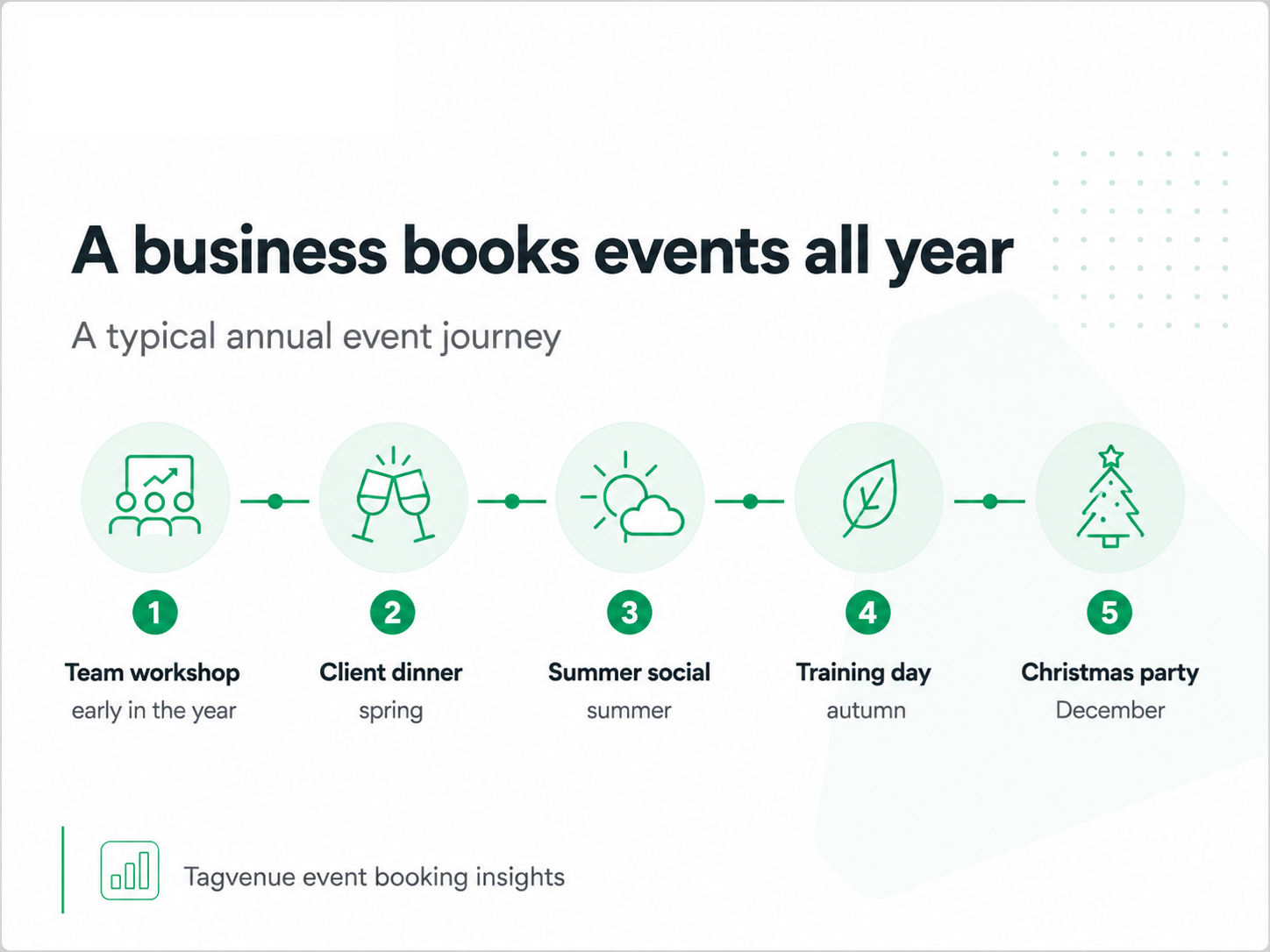
A business might book:
- A team workshop early in the year
- A client dinner in spring
- A summer social
- A training day in autumn
- A Christmas party in December
Individually, these may not attract the same attention as a large company-wide celebration. Together, they create a consistent calendar of face-to-face contact.
Around half of corporate bookers return to make at least one more booking within the same year.
What the Work Social Index tells us about company culture in 2026
The data points to five broad changes in how companies bring people together:
- The corporate calendar is becoming more varied.
Workshops, networking events and training sessions are growing faster than traditional parties. - Smaller gatherings are increasingly important.
Events for teams and departments account for a large share of demand and convert more strongly. - Workplace events are happening throughout the year.
Christmas remains important, but it is one of many reasons companies now hire venues. - The working week has changed.
Thursday has overtaken Friday as the most popular day for corporate events. - Face-to-face activity is recurring.
Around half of corporate bookers make more than one booking during the year.
Together, these patterns suggest businesses are not moving away from bringing employees and clients together.
They are doing it differently: in smaller groups, for more specific reasons and at more regular intervals.
Corporate event planning checklist for 2026
For HR, People and workplace teams planning their annual calendar, the Index provides several practical lessons.
Plan major seasonal events early
Begin searching approximately three months ahead for:
- Christmas parties
- Summer parties
- Large company celebrations
- Whole-company away days
Earlier planning provides a wider choice of venues, dates and packages.
Use shorter lead times for smaller working events
Meetings and small workshops can often be booked closer to the date.
Before enquiring, confirm:
- The preferred date
- Approximate headcount
- Location
- Room layout
- Catering requirements
- Accessibility needs
- Available budget
Clearer requirements can make it easier to compare venues and commit quickly.
Do not assume Friday is the best day
Consider Tuesday, Wednesday or Thursday, particularly for events that combine work and social activity.
Thursday is the most popular option, but Tuesday and Wednesday may offer greater venue availability.
Build a year-round calendar
Rather than allocating the entire budget to one large event, consider a mixture of:
- Workshops
- Team meals
- Training sessions
- Client events
- Departmental socials
- Seasonal celebrations
- Company-wide parties
This allows different teams and business needs to be supported throughout the year.
Methodology
The Tagvenue Work Social Index is based on corporate venue enquiries and confirmed bookings made through Tagvenue in the UK, Australia, Singapore and the US between January 2023 and July 2026.
Figures for 2026 cover the year to date and are not directly comparable with complete prior years.
Budgets have been converted into GBP using average annual exchange rates.
Event-purpose categories are based on the tags customers select when submitting an enquiry. Where an enquiry does not contain a clear category tag, it is excluded from that specific analysis rather than estimated.
Conversion refers to the proportion of enquiries that resulted in a confirmed booking through Tagvenue.
Repeat booking refers to companies that made more than one confirmed booking during the relevant calendar year.
The UK represents roughly two-thirds of the combined four-market dataset. Where a finding is specific to one market, this is stated in the article.
FAQs: Corporate events in 2026
What is the Tagvenue Work Social Index?
The Tagvenue Work Social Index is an analysis of corporate venue enquiries and confirmed bookings made through Tagvenue.
It examines how businesses meet, celebrate and connect, including the types of events they organise, their budgets, group sizes, locations, booking lead times and conversion rates.
The first edition covers activity in the UK, Australia, Singapore and the US from January 2023 to July 2026.
What are the biggest corporate event trends in 2026?
The main corporate event trends are the growth of workshops, training and networking events; increased demand for smaller gatherings; the rise of Thursday as the busiest event day; and a move towards recurring, year-round company activity rather than one annual party.
Are office Christmas parties declining?
No. Tagvenue enquiries for Christmas parties grew by 32% between 2024 and 2025.
However, networking, training and workshop enquiries grew faster. This suggests the Christmas party remains important but now forms part of a broader company events calendar.
How far in advance should a company book a Christmas party?
The median booking lead time for a Christmas party is 87 days.
Companies should therefore begin searching roughly three months before the event. For a December party, this means starting the venue search in September.
Large events or parties taking place on popular Thursday and Friday dates may need to be booked even earlier.
How far in advance should a company book a meeting room?
The median lead time for a corporate meeting is 17 days.
Availability will depend on the city, group size, room requirements and time of year, but many meeting rooms can be booked around two weeks ahead.
What is the most popular day for a corporate event?
Thursday is the most popular day for corporate events in the Tagvenue dataset.
It generated around 25,000 enquiries, compared with approximately 14,000 for Friday.
What size corporate events are most common?
Groups of 1–10 and 11–25 people are the two largest categories of corporate enquiry by volume.
This reflects strong demand for meetings, workshops, small team gatherings and departmental events.
Do smaller corporate events convert better than larger ones?
Yes. Enquiries for groups of 10 people or fewer convert at around 42%, compared with approximately 6% for groups of more than 250.
Smaller events typically require less budget, fewer approvals and simpler organisation.
How much do companies spend on corporate events?
Corporate event budgets vary considerably by country, city, group size and event type.
Just over 40% of enquiries in the Work Social Index had a budget below £500. The US had the highest average corporate event budget of the four markets, at £2,418.