Tagvenue Event Planning Index 2026: How the UK, US, Australia and Singapore Are Booking Events


From smaller guest lists to last-minute venue searches, the way people plan events is changing. Tagvenue analysed close to 750,000 venue enquiries across the UK, US, Australia and Singapore to see what people are booking, how much they’re budgeting and how far ahead they’re planning in 2026.
When it comes to booking events in 2026, three trends stand out:
- Last-minute venue enquiries are becoming more common.
- Median event budgets are flat or falling.
- Production and content-shoot enquiries are growing quickly.
But there isn’t one universal way people are celebrating. Singapore stands out for last-minute planning, US events tend to have the largest guest lists, Australia has seen events get smaller, and the UK has seen particularly strong growth in team building and kids’ birthday parties.
- Key findings from the Event Planning Index 2026
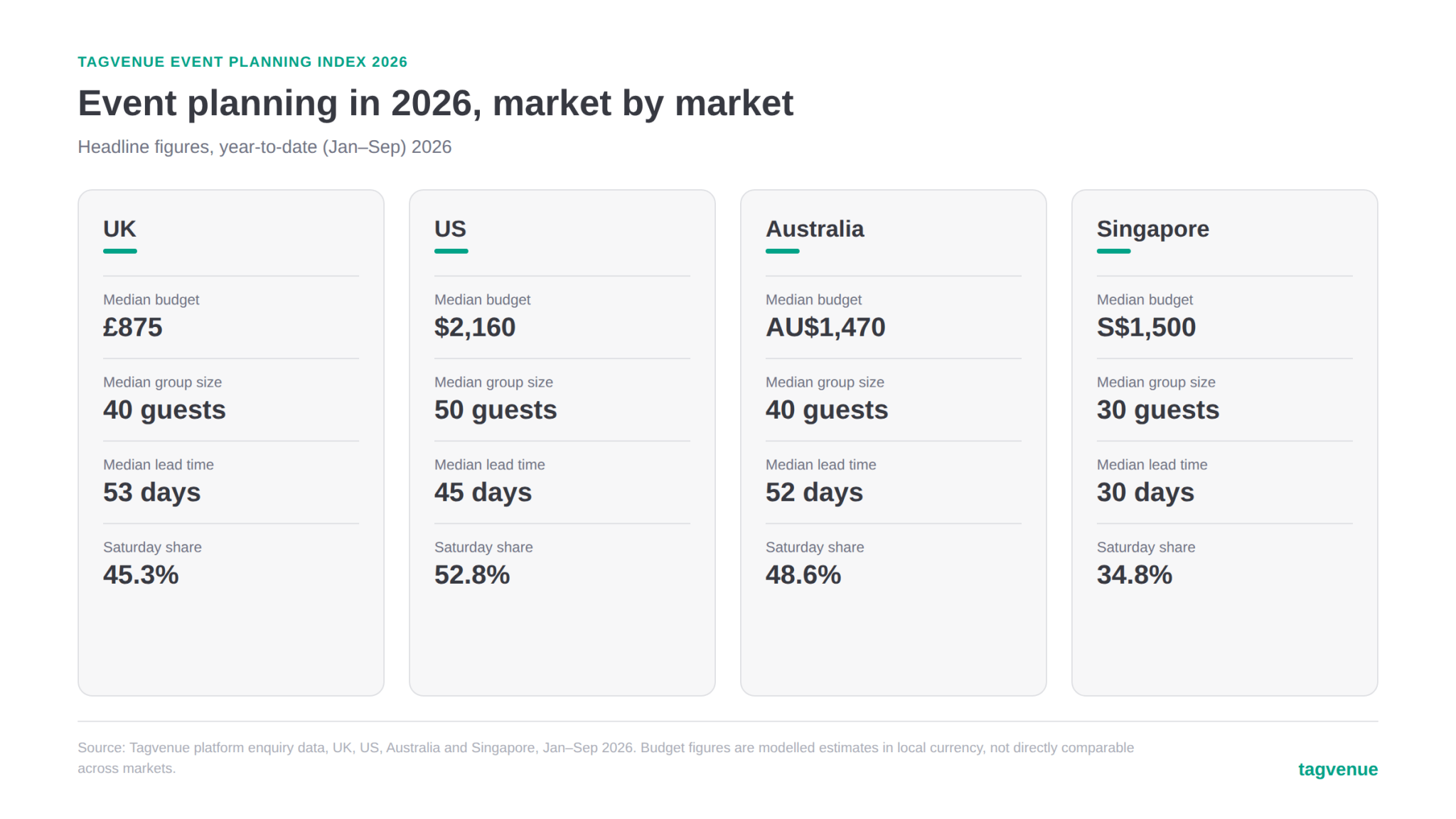
- Event planning in 2026 at a glance
- Are people booking event venues later than they used to?
- How much are people budgeting for events in 2026?
- What types of events are growing fastest?
- Is Saturday still the most popular day to hold an event?
- How are people planning events in the UK?
- How are people planning events in the US?
- How are people planning events in Australia?
- How are people planning events in Singapore?
- What does the Event Planning Index tell us about events in 2026?
- FAQs
Key findings from the Event Planning Index 2026
- Production and content-shoot enquiries are growing across all four markets, increasing 43.7% in the UK, 39.1% in Singapore, 85.8% in Australia and 273.3% in the US between 2023 and 2026.
- Median event budgets are flat or lower than in 2023: from £960 to £875 in the UK, AU$1,568 to AU$1,470 in Australia, S$1,507 to S$1,500 in Singapore and $2,250 to $2,160 in the US.
- Last-minute venue hunting is becoming more common everywhere. The percentage of enquiries made within seven days of an event has risen in all four markets.
- Singapore has the highest proportion of last-minute enquiries: 21.4% are made within seven days of the event.
- Saturday remains the most popular event day in every market, accounting for 52.8% of US events, 48.6% in Australia, 45.3% in the UK and 34.8% in Singapore.
Event planning in 2026 at a glance
| Market | Median budget | Median group size | Median lead time | Enquiries within 7 days | Saturday share |
| UK | £875 | 40 guests | 53 days | 12.6% | 45.3% |
| US | $2,160 | 50 guests | 45 days | 15.0% | 52.8% |
| Australia | AU$1,470 | 40 guests | 52 days | 13.9% | 48.6% |
| Singapore | S$1,500 | 30 guests | 30 days | 21.4% | 34.8% |
Budget figures are modelled estimates based on venue pricing and are shown in each country’s local currency, so they shouldn’t be used to directly rank countries by spend.
Are people booking event venues later than they used to?
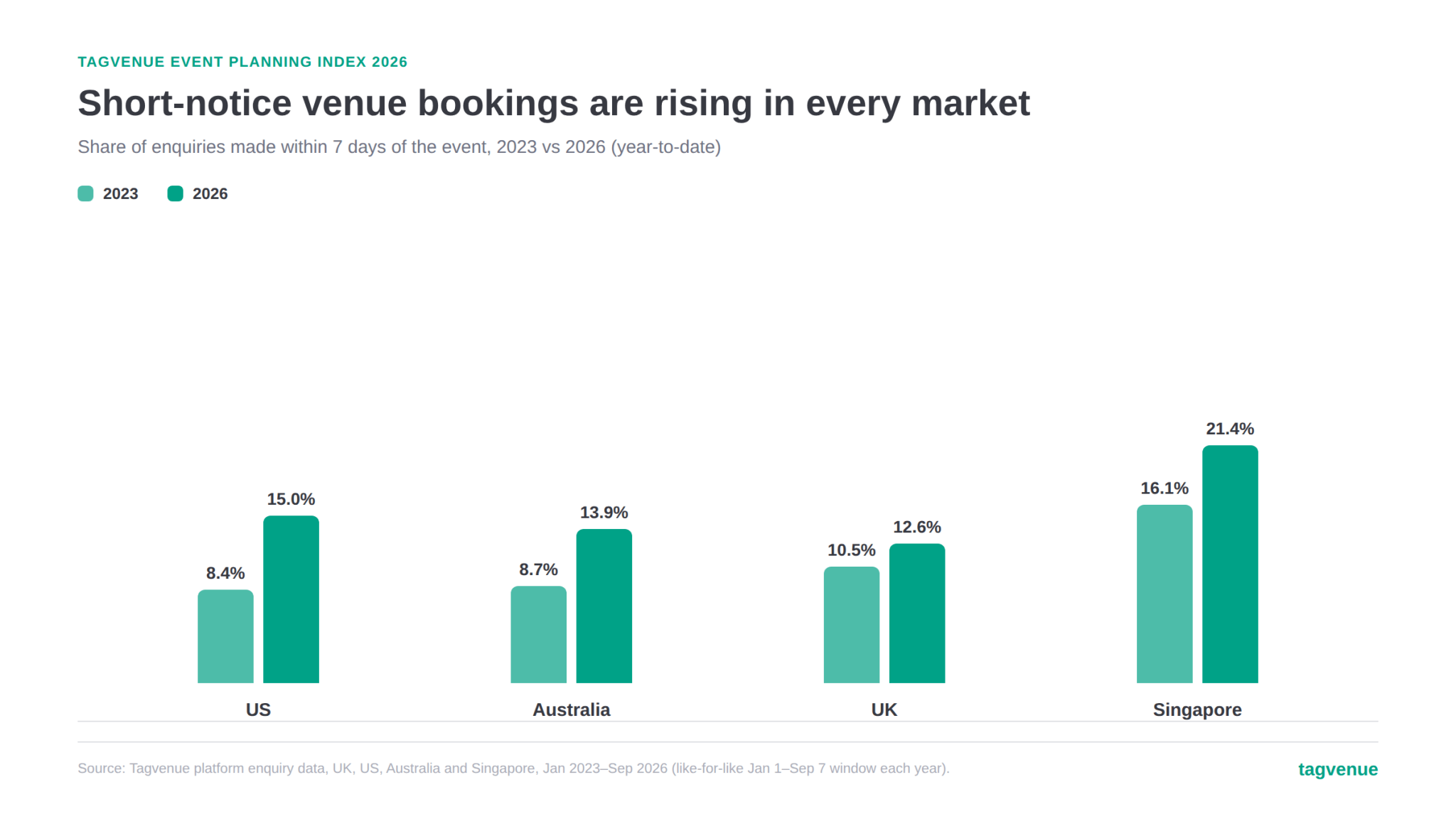
People aren’t necessarily becoming last-minute planners across the board, but short-notice venue enquiries are becoming more common in every market we analysed.
- In the US, the proportion of enquiries made within seven days of an event has risen from 8.4% in 2023 to 15.0% in 2026.
- Australia has seen a similar shift, from 8.7% to 13.9%, while the UK has moved from 10.5% to 12.6%.
- Singapore was already the most spontaneous of the four markets and has become even more so: 21.4% of enquiries are now made within seven days, up from 16.1% in 2023.
Look beyond that first week and the difference is even clearer. Just over half of Singapore venue enquiries are now made within 30 days of the event.
| Market | Median lead time 2023 | Median lead time 2026 |
| Australia | 62 days | 52 days |
| Singapore | 35 days | 30 days |
| US | 50 days | 45 days |
| UK | 52 days | 53 days |
Australia has seen the biggest reduction, with the typical planning window shortening by 10 days. Singapore and the US have both shortened by five days.
The UK is the exception. Its median has stayed remarkably stable, moving from 52 to 53 days.
So rather than everyone suddenly leaving their plans until the week before, the data suggests something slightly more interesting: the traditional planning window remains, but there’s a growing group of people comfortable finding a venue at very short notice.
How much are people budgeting for events in 2026?
Despite rising costs across many parts of everyday life over the past few years, the typical venue budget hasn’t followed the same trajectory.
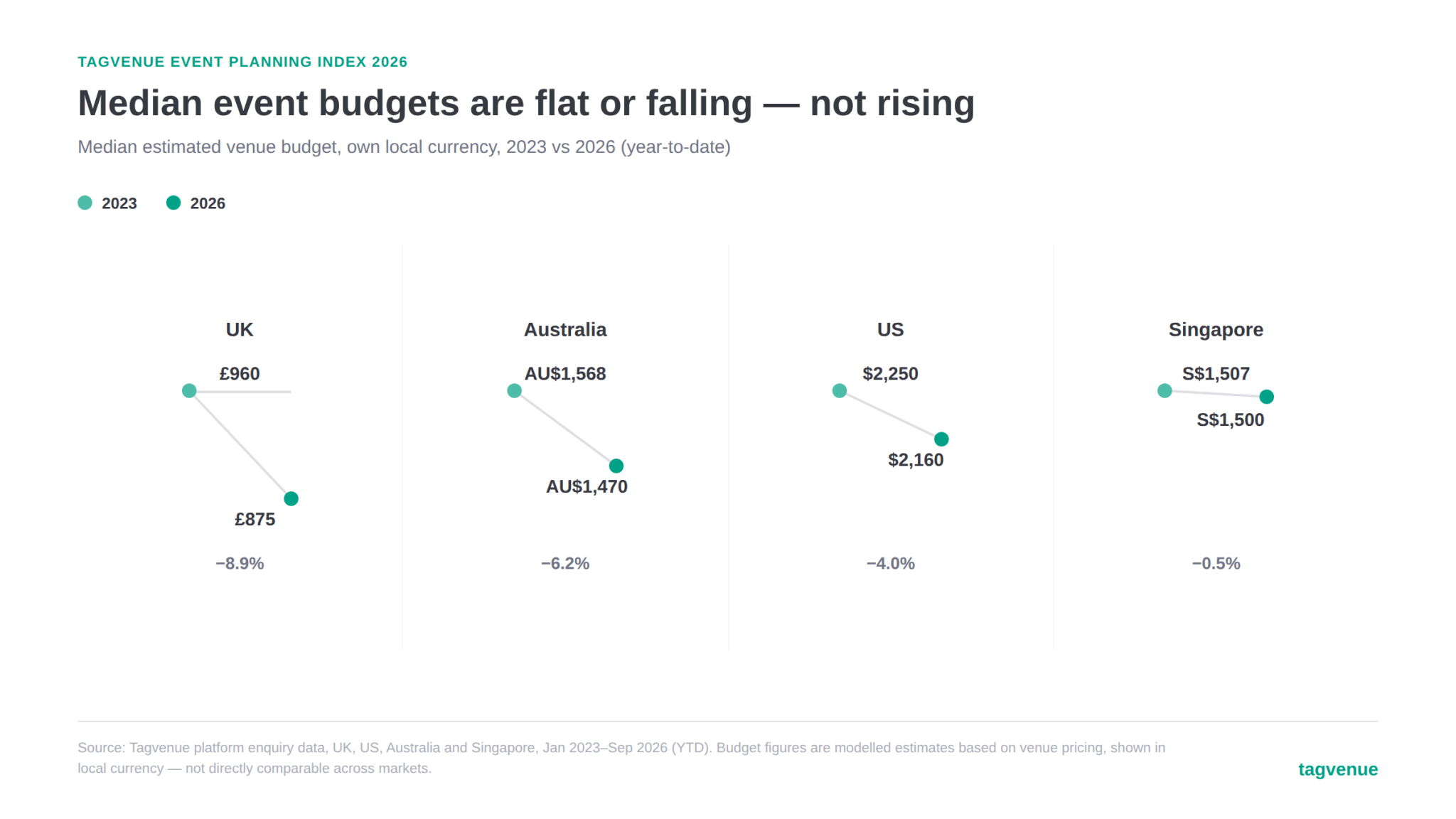
Median budgets have either fallen slightly or remained broadly flat across all four markets since 2023.
- In the UK, the median estimated event budget has moved from £960 to £875.
- In Australia, it’s fallen from AU$1,568 to AU$1,470, while the US has moved from $2,250 to $2,160.
- Singapore has barely changed at all, moving from S$1,507 to S$1,500.
That doesn’t necessarily mean every event is getting cheaper. These are the budgets and venue costs visible during the enquiry process rather than final transaction values, and the types and sizes of events being booked have changed too.
Australia is a good example. Its median event size has fallen from 50 guests in 2023 to 40 in 2026, while its median budget has fallen by a much smaller 6.2%.
In other words, at least some organisers may be scaling down the guest list rather than dramatically scaling down what they’re prepared to spend on the event itself.
What types of events are growing fastest?
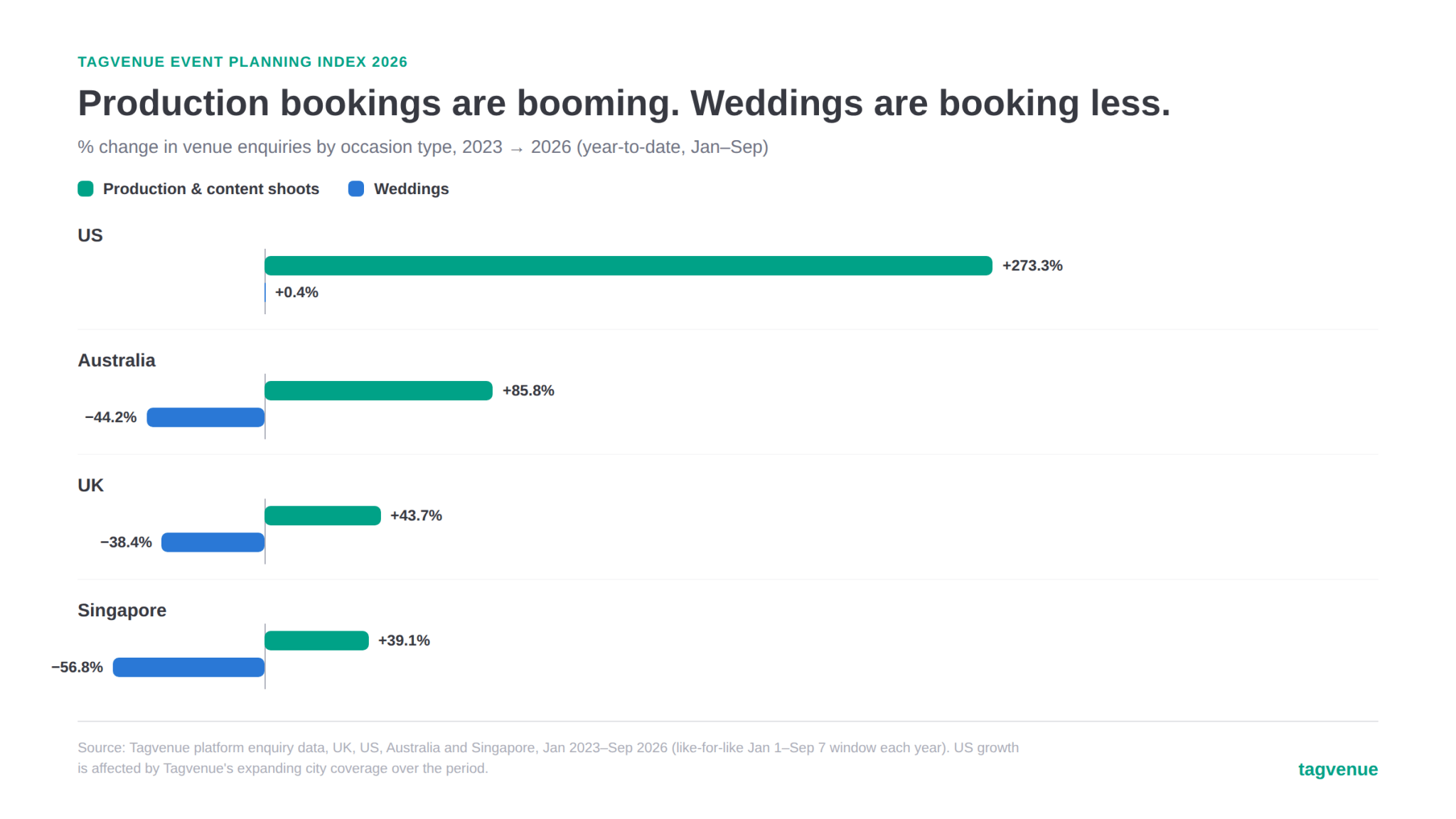
One of the clearest changes isn’t a traditional party at all.
Production enquiries, including photo shoots, film shoots and content creation, have grown in every market analysed.
| Market | Change in last 3 years |
| US | +273.3% |
| Australia | +85.8% |
| UK | +43.7% |
| Singapore | +39.1% |
Venue preferences support that shift too. Photo and film studio enquiries increased 143.8% in the US, 99.8% in Australia and 43.2% in Singapore over the same period.
It suggests the definition of an “event space” is becoming broader. A venue might be booked for a birthday on Saturday, a company gathering during the week and a content shoot the following morning.
For venues, that means demand increasingly comes from more than parties and traditional private events.
In the UK, team-building enquiries are up 165.4%. In Singapore, they’re up 88.8%. Singapore meeting enquiries have also grown 36.1%.
It points to a venue market serving an increasingly broad mix of reasons for people to get together — from private celebrations to work events and content creation.
Is Saturday still the most popular day to hold an event?
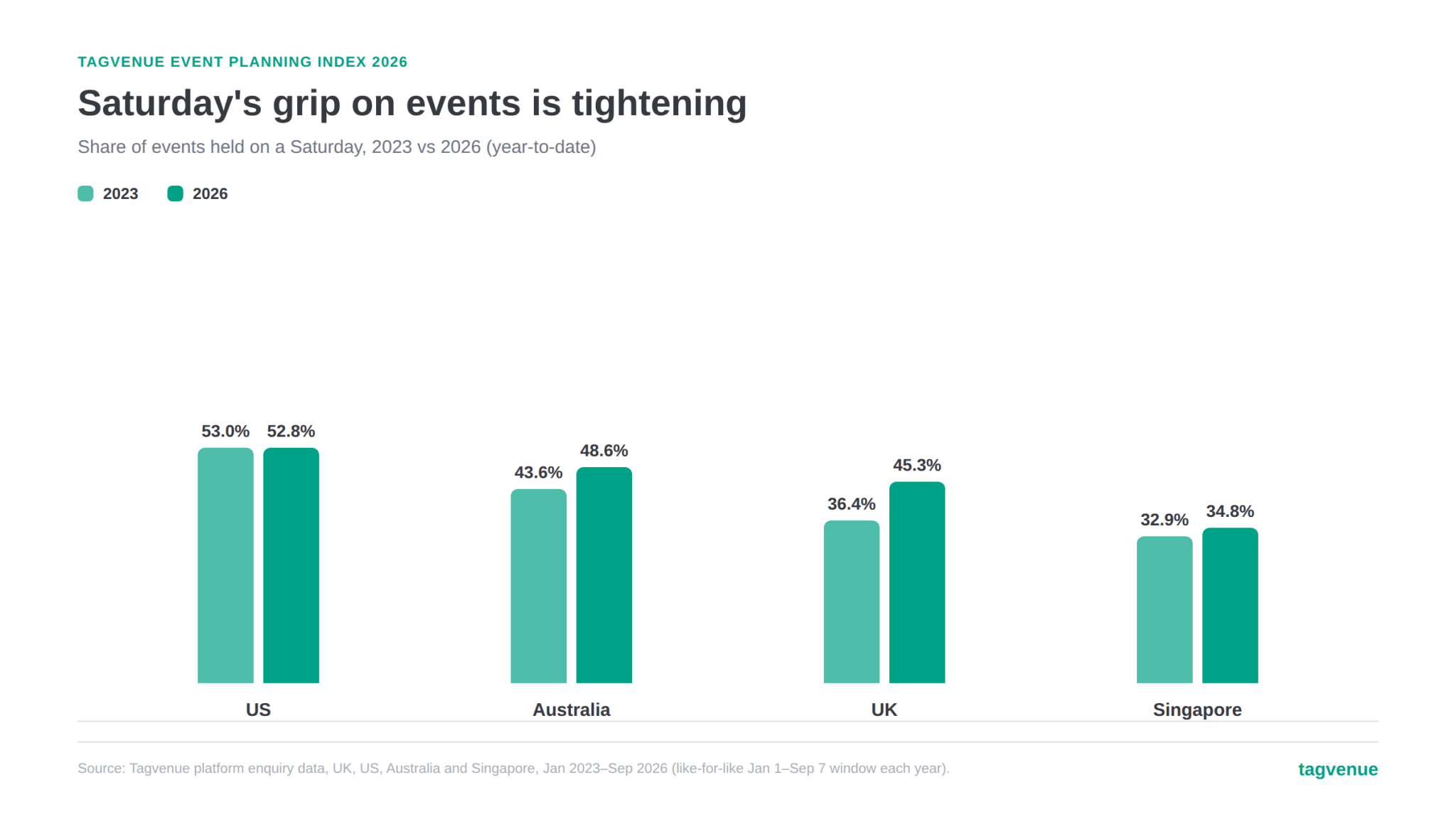
Saturday is the number-one event day in every market in the Index, and in three countries its share has increased since 2023.
- The biggest change has been in the UK, where Saturday accounted for 36.4% of events in 2023 and 45.3% in 2026.
- Australia has moved from 43.6% to 48.6%, while Singapore has risen from 32.9% to 34.8%.
- The US is different because Saturday was already dominant. It accounted for 53.0% of events in 2023 and remains almost unchanged at 52.8% in 2026.
- Singapore has the least Saturday-heavy event calendar of the four, suggesting events there are spread more evenly throughout the week.
How are people planning events in the UK?
- The typical UK enquiry is for 40 guests, with a median lead time of 53 days and a median estimated budget of £875.
- But some of the most interesting changes are in what people are booking.
- Among specific occasions with sufficiently large samples, kids’ birthday party enquiries have increased 278.1% since 2023.
- Team building has risen 165.4%, while graduation parties are up 89% and engagement parties 74%.
- At the same time, production has become a bigger part of the venue market, with enquiries rising 43.7%.
- So while the typical size and planning window of a UK event haven’t changed dramatically, the reasons people need spaces are becoming more varied.
How are people planning events in the US?
US events have the largest typical guest list of the four markets, with a median group size of 50 people in 2026.
The median estimated budget is $2,160, while the typical venue enquiry is made 45 days before the event.
There has also been a sharp rise in very short-notice planning. The proportion of enquiries arriving within seven days of an event has increased from 8.4% in 2023 to 15.0% in 2026 – the biggest increase of any of the four markets.
The occasions people are booking are changing too.
Graduation party enquiries through Tagvenue have increased 172.2%, since 2023, while general birthday party enquiries are up 121.6% and corporate event enquiries 119.7%. Production has seen particularly rapid growth, rising 273.3%.
How are people planning events in Australia?
Australians still tend to plan relatively far ahead, but not quite as far ahead as they did a few years ago.
Median lead time has fallen from 62 days in 2023 to 52 days in 2026, while the percentage of enquiries made within seven days has climbed from 8.7% to 13.9%.
Events have also become smaller. Median group size has fallen from 50 to 40 guests, the clearest change in event size among the four countries.
At the same time, production enquiries have grown 85.8%, while enquiries for photo and film studios have almost doubled, increasing 99.8%.
Saturday remains particularly important too: 48.6% of Australian events now take place on a Saturday.
Taken together, the picture isn’t necessarily one of Australians celebrating less. Instead, they’re increasingly looking for smaller events, booking slightly closer to the date and using venues for a wider range of purposes.
How are people planning events in Singapore?
Singapore is the clear outlier when it comes to last-minute planning.
The median venue enquiry is made 30 days before an event, compared with 45 days in the US, 52 in Australia and 53 in the UK.
More strikingly, 21.4% of Singapore enquiries are made within seven days of the event, and just over half are made within 30 days.
Despite the shorter planning window, event sizes have remained remarkably consistent. Median group size has stayed at 30 guests throughout the period.
Corporate use of venues is also growing.
Team-building enquiries have increased 88.8% since 2023, while meeting enquiries are up 36.1%. Meeting Centre and Office Space enquiries have also grown particularly strongly.
At the same time, Singapore has seen the biggest fall in wedding enquiries of the four markets, down 56.8%.
It’s a distinctive combination: relatively compact events, shorter planning windows and growing demand for spaces that can serve work and business occasions as well as celebrations.
What does the Event Planning Index tell us about events in 2026?
There isn’t one global event-planning trend. People in Singapore behave differently from people in the UK, just as an Australian venue enquiry looks different from one in the US.
But there are some common threads. People are increasingly comfortable looking for venues at short notice. Budgets aren’t rising significantly. Saturday is becoming more important. And the reasons people hire venues are broadening beyond traditional celebrations.
Perhaps the most interesting shift is the last one. Photo shoots, filming, content creation, team building and meetings are becoming a bigger part of venue demand alongside birthdays, weddings and parties.
For people planning events, that means more competition for spaces may come from occasions they wouldn’t traditionally have thought of as “events”.
And for venues, it means a space that works for more than one purpose could become increasingly valuable.
Methodology
The Tagvenue Event Planning Index analyses venue enquiries made through Tagvenue in the UK, US, Australia and Singapore between 2023 and 2026.
For year-on-year comparisons, the Index uses enquiries made between 1 January and 7 September in each year, allowing the partial 2026 period to be compared on a like-for-like basis.
Each enquiry is counted once, using the first venue contacted as representative of that customer’s planning journey.
Median figures are used for headline budgets, group sizes and planning times because a small number of very large events can disproportionately affect averages.
Budget figures are modelled estimates based on the pricing information available during the venue enquiry process and are not confirmed transaction values. Each market is reported in its local currency.
US growth figures should also be interpreted in the context of Tagvenue’s expansion into additional US cities during the period.
This is the country-level edition of the Tagvenue Event Planning Index 2026. Further analysis will look at how event planning differs between individual cities.
FAQs
How far ahead do people book an event venue?
In 2026, the median planning time is 53 days in the UK, 52 days in Australia, 45 days in the US and 30 days in Singapore. However, the percentage of enquiries made within seven days of an event has increased in all four markets since 2023.
Which country has the most last-minute event planners?
Singapore has the highest proportion of short-notice venue enquiries. In 2026, 21.4% of Singapore enquiries were made within seven days of the event and just over half were made within 30 days.
How many guests attend the typical event?
Median group size in 2026 is 50 guests in the US, 40 in the UK, 40 in Australia and 30 in Singapore.
How much do people budget for event venues?
The 2026 median estimated venue budgets are £875 in the UK, $2,160 in the US, AU$1,470 in Australia and S$1,500 in Singapore. These figures are in local currencies and are modelled estimates based on venue pricing, so they shouldn’t be directly compared to rank countries by spending.
What type of event is growing fastest?
Production and content-related venue enquiries are one of the clearest growth trends across all four markets.Production enquiries increased 43.7% in the UK, 273.3% in the US, 85.8% in Australia and 39.1% in Singapore between 2023 and 2026.
What is the most popular day to hold an event?
Saturday is the most popular event day in all four markets. It accounts for 52.8% of US events, 48.6% in Australia, 45.3% in the UK and 34.8% in Singapore in the 2026 data.
Related articles
See all
What Do Employees Actually Want From a Work Christmas Party in 2026?
Booking Through Tagvenue or Peerspace: Which platform is better for your event?