How to Price a Party Venue in London – Tips that Actually Work


Party venues are some of the highest-earning spaces in London, and also among the most competitive.
Tagvenue currently lists over 20,000 venues worldwide, with London representing one of its most active markets. During peak months such as June and December, party venues consistently rank among the most-viewed and most-enquired-about categories, and from analysing booking patterns, one trend is clear: some London venues secure high-value bookings months in advance, while others receive enquiries but struggle to convert.
The difference is the pricing strategy.
If you run a party venue in London, whether it’s a bar, rooftop, private room, warehouse space, or club-style venue, your pricing approach should reflect how this market behaves in real terms (peak scarcity, emotional purchasing, and high weekend concentration), so this guide breaks down how to price strategically, not just competitively.
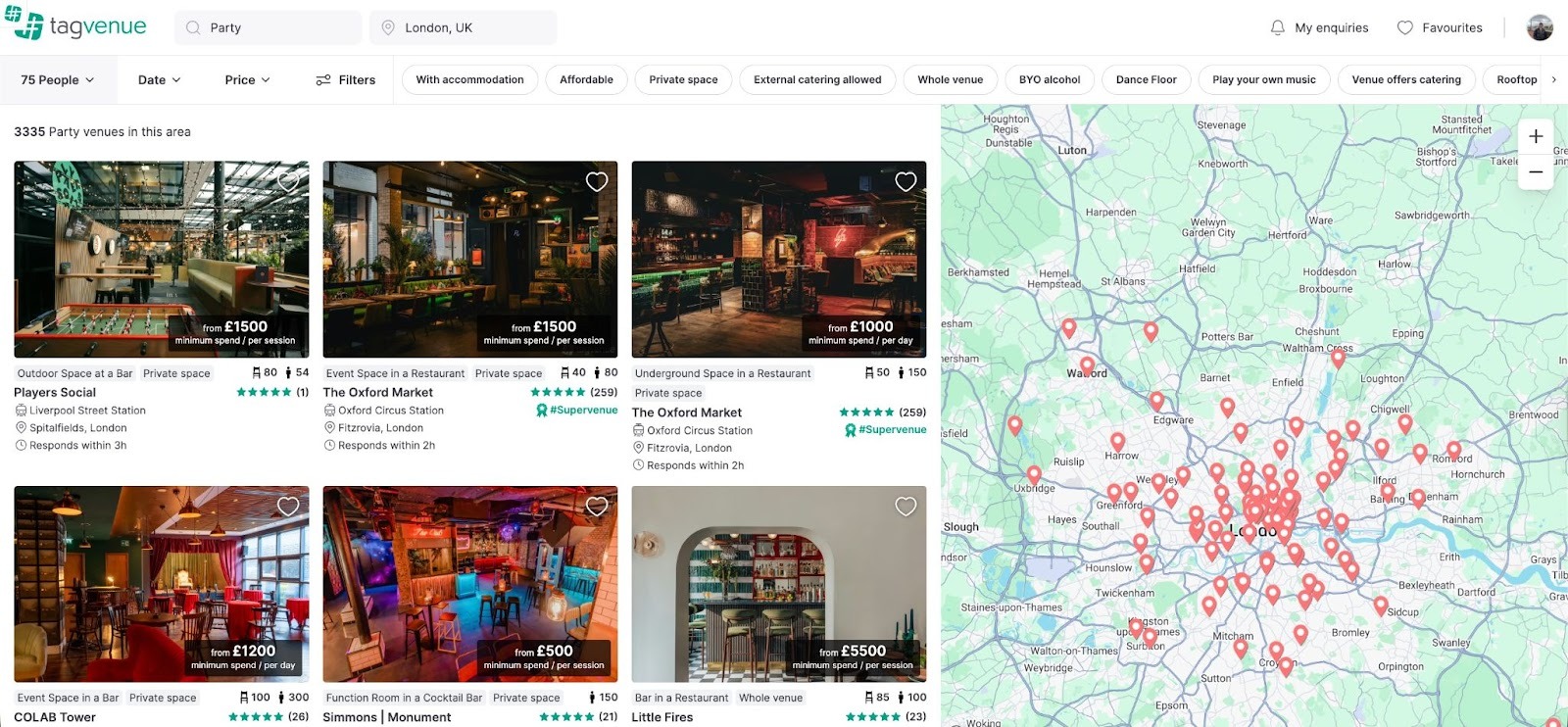
Party venues are one of the most competitive and active categories in London, with wide pricing variation depending on size, location, and exclusivity.
1. Why Party Venues Follow Different Pricing Logic
Corporate bookings are logical, but party bookings are emotional. A birthday host isn’t just booking square footage, they’re booking the atmosphere, so this is what party hosts really care about:
- Exclusivity
- Aesthetic appeal
- Lighting and atmosphere
- Bar setup and flow
That emotional element gives party venues pricing power. If your venue creates a strong experience through design, lighting, layout, or branding, your pricing should reflect that, because you’re not just selling space, you’re selling a memory.
Related: How to Price Your Venue: A Practical Tagvenue Guide for Small Businesses
2. Saturdays Are Your Gold Mine
For most London party venues, revenue is heavily concentrated on:
- Friday evenings
- Saturdays
- Peak months (May–July, November–December)
A Saturday night booking isn’t just another hire slot, it’s your highest-value asset. If your average Saturday minimum spend is £2,500 and you book 40 Saturdays per year, that’s £100,000 in revenue from Saturdays alone.
Now consider:
- Are you charging more for peak summer dates?
- Do December Saturdays carry a premium?
- Are bank holidays priced differently?
Underpricing peak nights doesn’t just reduce profit, it lowers your annual ceiling, and scarcity should influence price.
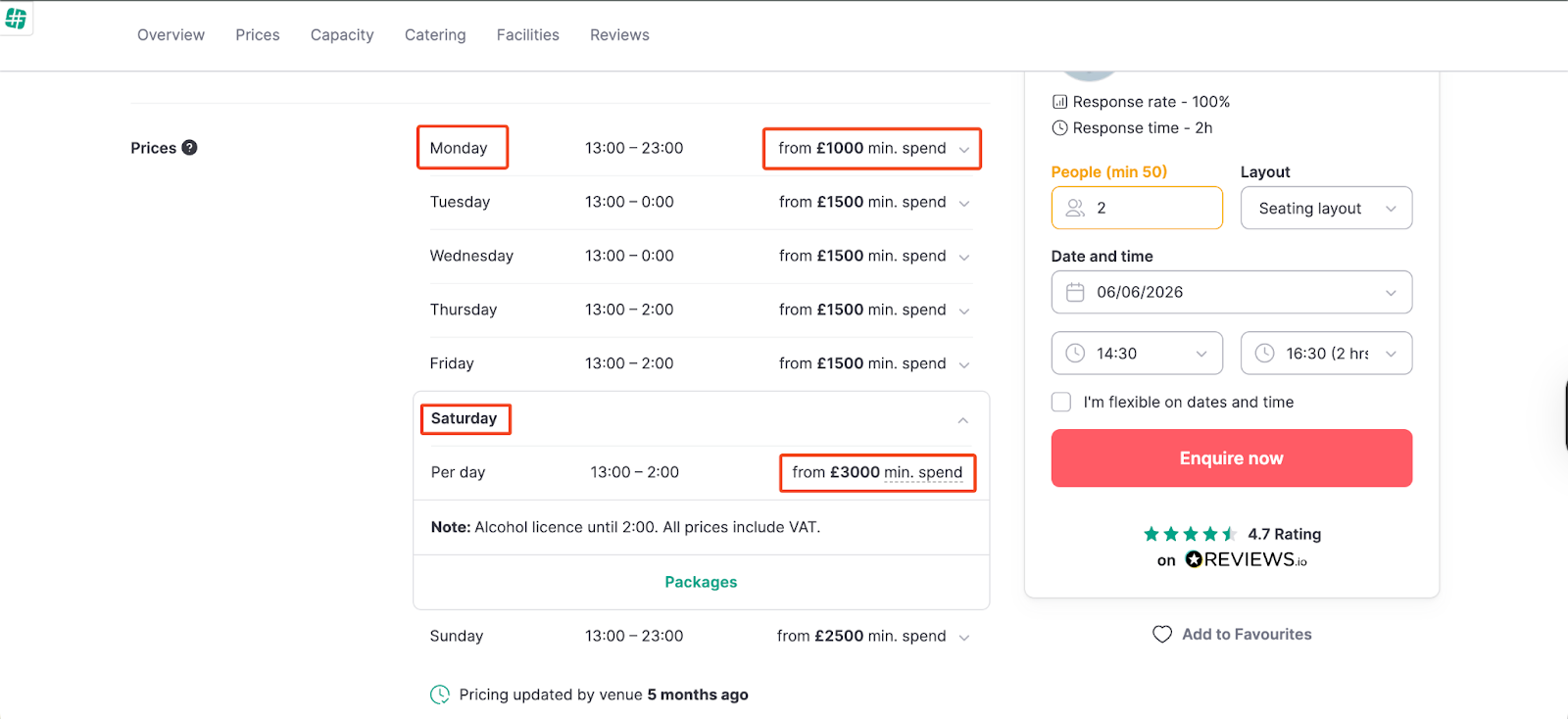
Many London party venues apply higher minimum spends for Fridays and Saturdays to reflect peak demand and opportunity cost.
3. Minimum Spend vs Party Packages: What Converts Better?
While minimum spend models are common, party hosts often respond better to clarity.
“£1,800 minimum spend” requires calculation.
“£2,200 Party Package (includes DJ, staff, welcome drinks)” feels easier to understand.
For party venues, structured packages can:
- Reduce negotiation
- Increase average spend
- Simplify decision-making
- Anchor pricing at a higher level
Tiered options such as Classic, Premium or Exclusive allow clients to choose based on budget without forcing you to discount your base value.
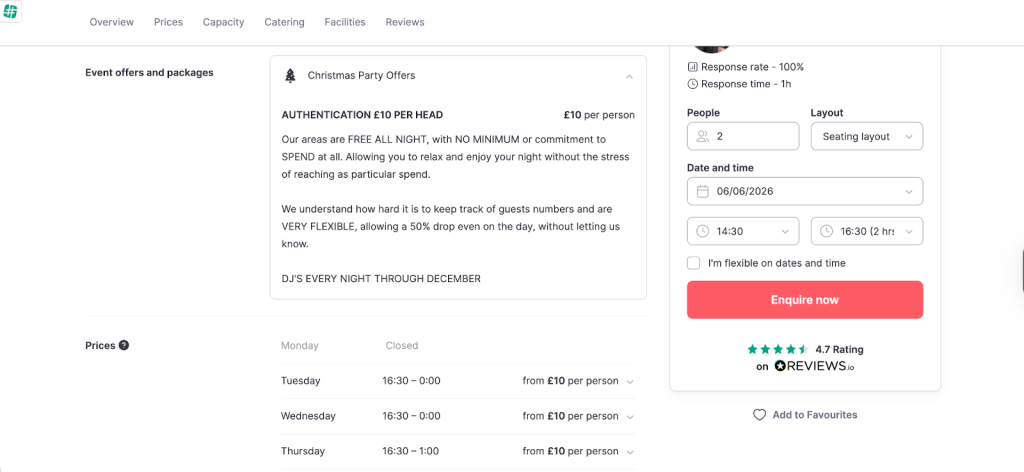
Clear party packages often convert faster than abstract minimum spend models, as they simplify decisions and increase perceived value.
Related: Smart Strategies for Setting Rates that Attract Bookings
4. Capacity Is Not the Same as Revenue
Many venues price strictly by headcount, but revenue doesn’t scale perfectly with capacity. A 50-person exclusive birthday in a private bar may generate more profit than a 120-person semi-private booking, depending on:
- Drink spend
- Bar margins
- Staffing requirements
- Duration
- Exclusivity
Instead of pricing only by capacity, consider:
- Per-head spend projections
- Margin per booking
- Staff-to-guest ratios
- Opportunity cost of full exclusivity
Party pricing should be revenue-led, not square-foot-led.
5. What Party Hosts Actually Pay For
When reviewing high-performing party venues across London, it becomes clear that hosts are willing to pay more for:
- Late licences
- Private access
- Dedicated bar space
- DJ booth or professional sound system
- Distinctive interior design
- Rooftop terraces or outdoor areas
- Instagram-worthy aesthetics
These are not minor features, they are price multipliers. If your venue offers any of these, they should be clearly reflected in both your listing and your pricing. Features like DJ booths, late licences, and strong visual identity often justify premium pricing in London’s party market.
6. London Pricing Benchmarks
While every venue differs by size and location, typical London party venue pricing often falls within these ranges:
- Small private party space: £800–£1,500 minimum spend
- Mid-size exclusive hire: £1,500–£3,000
- Central London premium venues: £3,000–£8,000+
- High-end rooftops or large-scale exclusive hires: £10,000+
Pricing depends on:
- Location
- Capacity
- Brand positioning
- Seasonality
- What’s included
Benchmarking is useful, but positioning determines where you sit within the range.
7. The Weekend Revenue Model
Let’s look at a simplified scenario: If your venue averages:
- £2,500 per Saturday
- £1,800 per Friday
- £1,200 per midweek private event
You could generate well over six figures annually from private parties alone, without expanding your space. The opportunity already exists; the question is whether pricing captures it.
8. Price the Experience, Not Just the Space
Party venues operate at the intersection of scarcity, emotion, and atmosphere, and your pricing should reflect all three.
- Peak-date demand plays a major role. Fridays, Saturdays, and key months like June and December carry a higher opportunity cost. If a Saturday evening can only be sold once, its value is naturally higher than a midweek afternoon. Pricing should recognise that limitation.
- Weekend scarcity is equally important. A venue might have multiple weekday opportunities to generate revenue, but only a limited number of prime weekend slots. Underpricing those high-demand dates doesn’t increase competitiveness, it lowers overall annual revenue potential.
- Experience value also matters. Elements like lighting, music capability, exclusivity, décor, and atmosphere influence what guests are willing to pay, and a venue that delivers a distinctive setting commands stronger pricing than one positioned as purely functional.
And while party bookings are emotional decisions, they’re still tied to perceived value. Hosts compare venues based on how special, smooth, and memorable the event feels likely to be, not just on square footage.
Strong positioning combined with thoughtful pricing makes the difference between appearing in search results and consistently securing high-value weekend bookings.
Related articles
See all
How to Transform Your Venue into a Multi-Purpose Event Space and Boost Revenue